Extended Exchange Review 2026: Fees, RWA Perpetuals, Trading UI, and Risks
This Extended Exchange review assesses its live trading UI, crypto and RWA markets, fees, order types, security documentation, deposits, competitors, and…


Extended Exchange Review 2026: A Strong Public Trading Terminal With Important Documentation Gaps
By Editorial Team | Last verified October 29, 2026
Meta description: This Extended Exchange review assesses its live trading UI, crypto and RWA markets, fees, order types, security documentation, deposits, competitors, and risks.
Extended Exchange is a perpetual DEX that combines crypto markets with real-world-asset references such as equities, indices, commodities, and FX. Its public terminal is unusually informative before wallet connection: I could inspect a BTC-USD chart, live depth, funding, open interest, market categories, order controls, and account tabs without signing in.
The assessment combines a live public-interface walkthrough recorded on October 29, 2026 with current Extended documentation. The captures show the market-selection, charting, order-book, order-entry, margin, and account layouts available before login.
Quick verdict
Extended's best qualities are its broad market selector, clean chart/book/ticket layout, flat published fees, and the amount of data visible before login. The terminal feels designed for an active derivatives trader rather than a beginner. Crypto, RWA, perpetual, and spot filters sit in one selector, while funding, open interest, volume, leverage labels, RFQ markers, and account-risk fields are close to the order ticket.
The main weaknesses are equally practical. A competition modal covered the screen on first load; wallet-gated fields showed dashes instead of a preview of effective fees; the public ticket did not make leverage adjustment or the full advanced-order workflow obvious; and the current documentation is in transition. Extended's architecture page says settlement is on Arc, while the API documentation fetched the same day still describes Starknet endpoints and Stark signatures. Anyone integrating or depositing should confirm which stack and routes apply to the live account rather than relying on one page.
| Area | What stood out |
|---|---|
| Trading screen | BTC-USD chart, live order book, mark/index prices, funding, volume, OI, order ticket, and account tabs fit on one desktop view |
| Market discovery | Perpetual/Spot, Crypto/RWA, 14 subcategories, leverage labels, and RFQ markers make cross-market scanning fast |
| Fees | Official flat 0% maker / 0.025% taker; RWA markets use 0% / 0.010% |
| Order toolkit | Market, Limit, Conditional, TWAP, Scaled, Chase, Reduce Only, and TP/SL are documented |
| Security design | The documentation describes self-custody, on-chain checks, external audits, and a public audit competition |
What is Extended Exchange?
Extended describes itself as a perpetual DEX built by an ex-Revolut team. Its overview says the platform covers more than 300 crypto and RWA markets, supports leverage up to 100x, uses USDC as base collateral, and is building toward unified margin across perpetuals, spot, lending, and additional products.
The team page identifies a founding group with backgrounds in Revolut crypto, exchange architecture, engineering, and McKinsey. That is useful operator disclosure, but it remains a self-description rather than an independent assessment of governance or operational controls.
The current technical architecture page says user funds are self-custodied in smart contracts and transactions settle on Arc, Circle's EVM-compatible Layer 1. It also says collateral-changing events, including trades, funding payments, transfers, liquidations, and ADLs, trigger on-chain health checks. These controls reduce reliance on a centralized custodian, while code, oracle, bridge, signing, market, and governance risks still remain.
Hands-on public trading experience
First load: useful data behind a promotional modal
The first full screen loaded a dark BTC-USD terminal, but a "Final Arc Competition" modal covered the center. It advertised a $250,000 USDC and 750,000 Xpoints pool for an October 6-November 3 competition. The modal had clear Learn more and Got it actions, but it delayed access to the chart and order book.
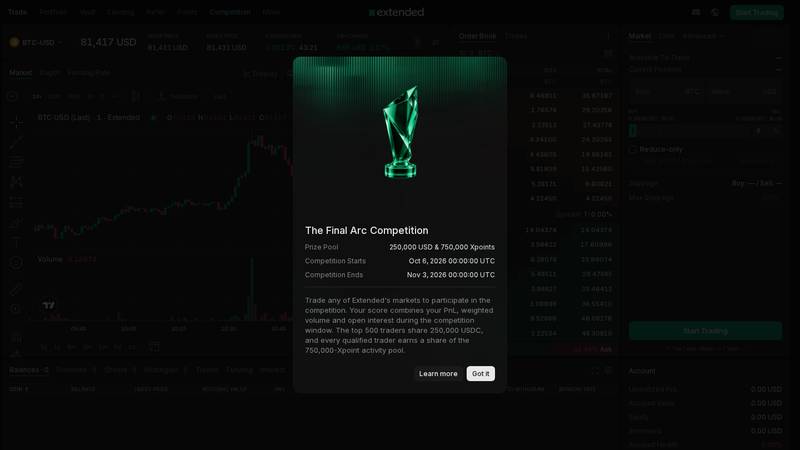
Capture 01, October 29, 2026. The promotional modal is the main first-load interruption.
After dismissing it, the core workspace was easy to parse. The header showed BTC-USD, mark and index prices, funding, 24-hour change, open interest, and volume. The chart offered Market, Depth, and Funding Rate views plus Trading Rules and Margin Schedule links. The center-right book displayed live asks and bids; the right ticket offered Market, Limit, and Advanced tabs.
The observed BTC mark price moved around $81,100, while the book and statistics refreshed during capture. Those figures are volatile evidence of a functioning public display, not current quotes for a reader.
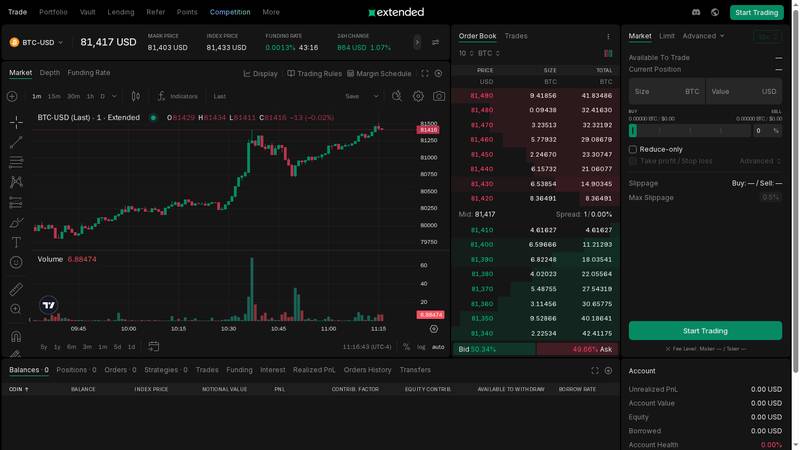
Capture 02, public desktop view at 1440×810. Prices, funding, volume, and open interest are a point-in-time snapshot.
Market selector: the strongest part of the public experience
Clicking BTC-USD opened a large selector with three layers of filtering:
- Product type: All, Perpetual, Spot
- Asset class: All, Crypto, RWA
- Subcategories: All, Pinned, AI, Commodity, DeFi, ETF/Index, Equity, FX, Infra, L1, L2, Meme, Pre-market, Stable
Each row combined last price, 24-hour change, funding rate, open interest, volume, and a maximum-leverage label. The capture included BTC and ETH at 50x, XAU at 25x, WTI at 10x, NDX at 20x, SPX at 25x, and JP225 at 25x with an RFQ tag. That mix makes comparison fast, but the leverage badge is a ceiling or market parameter rather than a recommended setting.
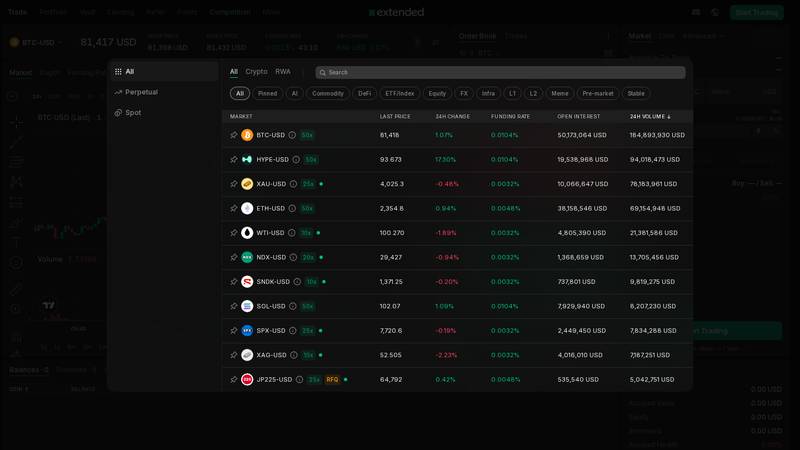
Capture 03, the selector makes asset class, market data, and RFQ status visible in one table.
The selector's main trade-off is density. More than 30 instruments were available to scroll during the walkthrough, and similarly named order-book and RFQ markets can behave differently. The app helps discovery; it does not remove the need to read a market's trading rules, oracle source, session, and liquidation parameters.
Order ticket and account area
Before login, the ticket exposed Size in BTC, Value in USD, a percentage slider, Reduce-only, slippage information, and Buy/Sell sides. The Take profit / Stop loss row was visible but inactive in the default state. Available to Trade, Current Position, and maker/taker fee level displayed dashes until an account is connected.
The bottom account area showed Balances, Positions, Orders, Strategies, Trades, Funding, Interest, Realized PnL, Orders History, and Transfers. Personal values remained zero or blank before login, while the surrounding layout showed how balances and position history are organized.
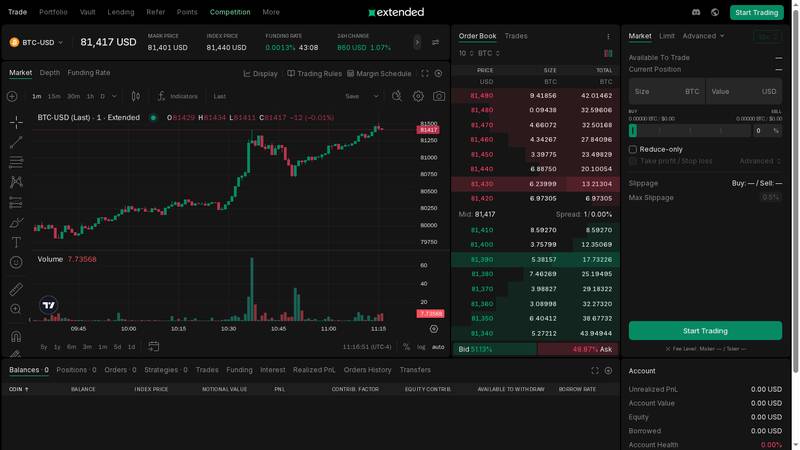
Capture 04, the order-entry and account panels before login.
Trading rules and margin schedule
The BTC-USD Trading Rules panel displayed a 0.0001 BTC minimum trade size, 0.00001 BTC size increment, $1 minimum price change, $3 million maximum market order, $15 million maximum limit order, $60 million maximum position value, and 200 open orders. These values can change by market, so the panel is more useful than assuming one global rule set.
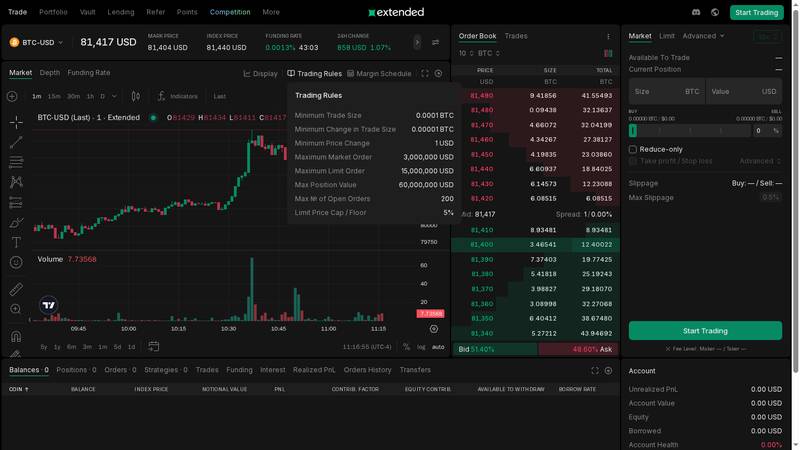
Capture 05, BTC-USD market rules displayed inside the trading screen.
The Margin Schedule also made the relationship between position size and leverage explicit. The captured first tier covered positions from $0 to $4 million with 50x maximum leverage, 2% initial margin, and 1% maintenance margin. Higher brackets progressively reduced leverage and increased both margin requirements.
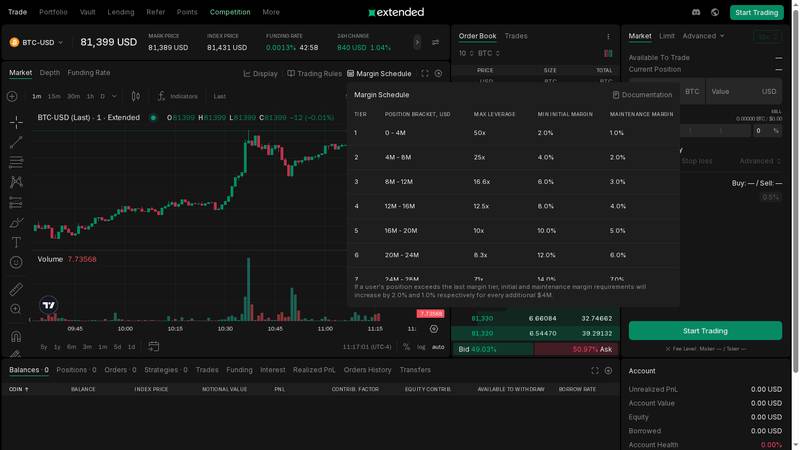
Capture 06, margin requirements rise as the position bracket increases.
Order types: more capable than the default ticket suggests
The public ticket grouped orders under Market, Limit, and Advanced, but the official order-type documentation describes a wider toolkit:
| Order or condition | Documented use |
|---|---|
| Market | Immediate execution at prevailing price for perpetual and spot markets |
| Limit | Execution at the chosen limit or better |
| Conditional | Triggers a market or limit order from Mark, Index, or Last Price |
| TWAP | Splits a perpetual order across time to reduce impact |
| Scaled | Places multiple limits across a selected range |
| Chase | Reprices a post-only limit toward best bid/ask; unavailable for RFQ |
| Reduce Only | Decreases a perpetual position rather than opening the opposite side |
| TP/SL | Position, partial-position, and order-linked exit conditions |
Opening the Advanced menu exposed Chase, Conditional, Scaled, and TWAP directly in the ticket. This makes the documented toolkit easier to reach than the three top-level tabs initially suggest.
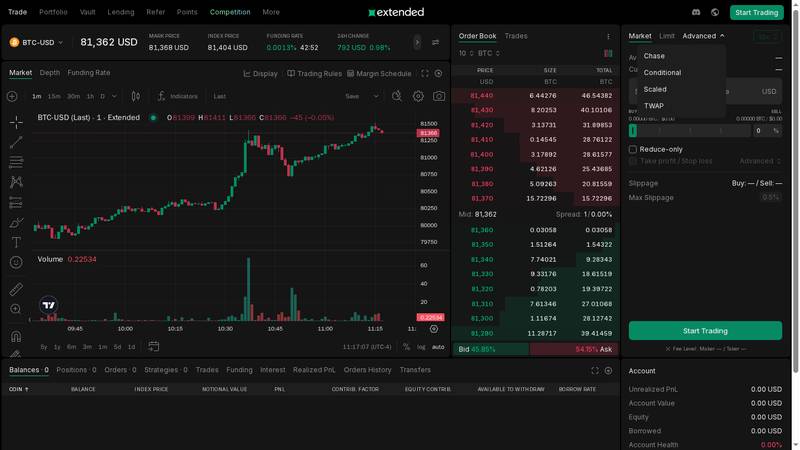
Capture 07, Advanced order choices available from the public ticket.
One implementation detail deserves attention: the documented Chase strategy runs in the browser tab. Closing or refreshing the tab, switching accounts, or disconnecting the wallet pauses repricing while leaving the last limit order live until it fills, is canceled, or expires under the documented conditions. That is a meaningful operational risk for anyone treating Chase as a server-side autonomous strategy.
Visible controls also do not guarantee a fill. Market orders can cross available depth; limits can remain open; conditional orders can activate into fast conditions; and TP/SL cannot eliminate gap or liquidity risk. The safe interpretation is that Extended provides several ways to express an order, not several ways to guarantee an exit.
Fees and a like-for-like comparison
Extended's published fee page uses a simple flat schedule:
| Market type | Maker | Taker |
|---|---|---|
| Standard perpetual and spot | 0.000% | 0.025% |
| RWA | 0.000% | 0.010% |
For a $10,000 notional position opened and closed entirely as a standard taker, listed trading fees would be about $5.00. The same round trip on an RWA market would be about $2.00. These illustrations exclude spread, slippage, funding, bridge costs, borrowing, price movement, and any future fee change.
For a dated like-for-like benchmark, Hyperliquid's official fee page listed a Tier 0 perpetual base rate of 0.045% taker and 0.015% maker when fetched on October 29. A $10,000 taker open-and-close at that base rate is approximately $9.00 before the same omitted costs. Hyperliquid tiers, staking discounts, growth-mode markets, and rebates can lower effective rates, so this is a base-rate comparison rather than a claim that every Extended trade is cheaper.
Extended also publishes maker rebates based on 30-day market share. Standard rebates range from 0.002% at at least 0.5% share to 0.010% at at least 5%; RWA rebates are lower. They accrue automatically and are paid daily only when the prior day's rebate reaches at least $10. Most retail users should treat those as professional-liquidity incentives, not assume they will receive a negative effective maker fee.
Extended vs Hyperliquid, dYdX, and Ostium
Extended competes in two overlapping groups. Hyperliquid and dYdX are order-book perpetual venues with volume-based fee systems, while Ostium targets many of the same RWA categories through a different bid/ask and oracle-driven model. Comparing only the headline fee would hide those structural differences.
| Platform | Market and execution model | Published cost structure | Where it stands out | Main trade-off |
|---|---|---|---|---|
| Extended | Crypto, equities, FX, commodities, indices, spot, order-book perps, and RFQ markets | 0% maker and 0.025% taker on standard markets; 0% and 0.010% on RWA | One selector combines crypto and RWA, with advanced orders and market-level margin schedules | Arc migration material and Starknet API pages are not yet fully synchronized |
| Hyperliquid | HyperCore order books for perpetuals and spot, plus HIP-3 deployed markets | Tier 0 perps: 0.015% maker and 0.045% taker before discounts and rebates | Deep crypto-native ecosystem, on-chain market state, staking discounts, and volume tiers | Base fees are higher than Extended's published flat rates; effective cost varies by tier and market mode |
| dYdX | Perpetual order books on dYdX Chain with chart, depth, leverage, positions, and order history | Volume-tiered maker/taker fees over trailing 30-day volume; settings can change through governance | Mature perpetual workflow and chain-level governance | The effective fee requires checking the current frontend tier rather than relying on one permanent rate |
| Ostium | 75 perpetual instruments across stocks, ETFs, commodities, indices, FX, and crypto using bid/ask execution | 3 to 10 bps opening fee, $0.10 oracle fee, continuous rollover, and conditional early-close fee | Focused global-markets coverage with explicit native market hours | Cost is not a simple maker/taker comparison, and rollover can dominate longer holding periods |
Cost reference for a $10,000 position
| Platform or market | Published starting cost | Important exclusions |
|---|---|---|
| Extended standard market, taker open and close | About $5.00 | Spread, slippage, funding, borrowing, and bridge cost |
| Extended RWA market, taker open and close | About $2.00 | Spread, slippage, funding, market-session effects, and bridge cost |
| Hyperliquid Tier 0 perp, taker open and close | About $9.00 | Tier discounts, staking discounts, growth mode, spread, slippage, and funding |
| dYdX | Depends on the active 30-day volume tier | Current governance parameters, spread, slippage, and funding |
| Ostium | $3 to $10 opening fee plus a $0.10 oracle request | Rollover, bid/ask spread, early-close conditions, and additional oracle actions |
Extended has the lowest published starting fee in this specific base-rate comparison, especially for RWA taker flow. Hyperliquid may become more competitive through tiers and discounts, dYdX depends on the active governance schedule and user volume, and Ostium uses a different cost model that becomes more sensitive to holding time.
Architecture, audits, and the documentation transition
Extended's security case has three layers in its own materials:
- The architecture page describes self-custodied contracts, on-chain risk checks, external oracle conditions for liquidation, and zero-knowledge proof verification.
- The audit page says the on-chain logic and contracts have been reviewed by ChainSecurity and through a public audit competition.
- The API documentation says read-only calls use an API key while order, transfer, and withdrawal operations also require a Stark signature.
The complication is that these pages do not currently tell one perfectly synchronized story. The architecture page, updated October 27, says settlement is on Arc and emphasizes EVM compatibility. The API documentation fetched October 29 still identifies Starknet mainnet endpoints, Stark keys, Stark signatures, and Starknet settlement. This should be treated as a migration documentation gap that must be resolved against the live application before funding or integration.
Before funding an account or building an integration, confirm the live network, contract addresses, wallet type, bridge route, signing domain, and API endpoints in the application and current migration documentation. Do not reuse an older Starknet workflow merely because an API example remains online, and do not assume every Arc statement already applies to every live endpoint.
The audit page is evidence of external review rather than a safety certificate. Users should check report scope, commit hashes, unresolved findings, deployed bytecode, upgrade controls, and bridge contracts. Audits reduce uncertainty, but they do not remove smart-contract, oracle, bridge, or operational risk.
Deposits and withdrawals
The deposit and withdrawal documentation lists USDC, cirBTC, and ETH. For EVM-wallet users it documents routes across combinations of Ethereum, Arbitrum, Base, Arc, BNB Chain, Polygon, and Avalanche. It also warns that timing and limits depend on Rhino.fi bridge liquidity.
This is convenient but adds route risk. A user must match the asset, source chain, destination, wallet type, and live bridge instructions. The documentation lists typical processing times from roughly one minute to several hours depending on chain, asset, and size; those are estimates rather than guarantees.
A safer first funding workflow is to use a small test deposit on the exact route shown in the connected account, wait for it to credit, then make a small withdrawal back to the intended destination before committing meaningful collateral. The live confirmation screen should be treated as the final source for minimums, fees, and route availability.
Regional access and other material risks
The restricted-countries page currently includes the United States, United Kingdom, Canada, China (Hong Kong), Russia, and several other jurisdictions. It also restricts access wherever use would conflict with applicable law. Eligibility should be checked before opening an account or moving collateral.
Other risks remain even for an eligible user:
- Leverage and liquidation: the selector showed ceilings from 10x to 50x in the captured rows, while the overview advertises up to 100x. Maximum leverage is a risk limit, not a sensible default.
- RWA session and oracle risk: an equity, index, commodity, or FX reference can have market hours, closures, gaps, and oracle behavior that differ from 24/7 crypto.
- RFQ versus order-book execution: an RFQ marker indicates a different execution model. Quote availability and expiry can differ from visible central-limit-book depth.
- Funding and borrowing: the displayed funding rate changes. Unified-margin and lending features can add interest and cross-collateral dependencies.
- Bridge risk: deposits and withdrawals may rely on external bridge liquidity and infrastructure.
- Documentation drift: network, route, and API instructions can lag a migration. Confirm live details before signing.
Who is Extended for?
Extended is best suited to experienced perpetual traders who want crypto and RWA references in one workspace, value an order-book interface, and are willing to read market-specific rules. Market makers may also find the zero published maker fee and volume-share rebate schedule attractive, subject to actual liquidity and eligibility.
It is less suitable for beginners seeking simple spot ownership, anyone who interprets an RWA perpetual as a stock or commodity holding, users in restricted jurisdictions, or traders unwilling to manage leverage, funding, liquidation, bridge, and oracle risk. The public interface is approachable; the product underneath it is not simple.
A safer way to start
- Check eligibility first. Read the current restricted-countries page and terms without attempting to route around them.
- Identify the exact market model. Confirm perpetual versus spot, Crypto versus RWA, and order book versus RFQ.
- Read Trading Rules and Margin Schedule. Verify leverage, collateral contribution, maintenance margin, oracle, funding, and trading session.
- Confirm the live network and route. Reconcile Arc migration information with the connected wallet, contract addresses, bridge, and current API documentation.
- Test funding with a small amount. Deposit and withdraw a small sum before increasing collateral.
- Use low leverage for the first controlled trade. Do not copy the 50x or 100x marketing ceiling.
- Calculate total cost. Include maker/taker fee, spread, slippage, funding, borrowing, and bridge cost, not just the 0.025% headline.
- Treat advanced orders as tools, not guarantees. Understand Chase tab dependence, TP/SL triggers, and RFQ behavior before relying on them.
Verdict
Extended delivers one of the more informative public perp-DEX terminals I have tested: the interface loaded cleanly through an eligible observation route, exposed real-time market context without login, and made crypto and RWA discovery unusually fast. Its flat fee schedule is competitive at the published base rate, and its documented order toolkit extends well beyond the three default ticket tabs.
The biggest issue is not the trading layout but the documentation transition. Current Arc architecture material and Starknet-oriented API documentation need to be reconciled before a user or developer assumes a particular network workflow. Extended is most compelling for experienced traders who value low published fees, RWA breadth, and advanced orders, while remaining willing to validate each market, route, and signature flow.
FAQ
Is Extended Exchange a DEX?
Extended describes itself as a self-custodial perpetual DEX. Its current architecture documentation says user funds remain in on-chain contracts and risk checks are enforced on-chain. That description does not eliminate contract, oracle, bridge, or market risk.
What are Extended's trading fees?
The current published schedule lists 0% maker and 0.025% taker for standard perpetual and spot markets, and 0% maker / 0.010% taker for RWA markets. Effective total cost also includes spread, slippage, funding, borrowing, and bridging.
Does Extended offer stocks and commodities?
The selector includes RWA references such as equity, index, commodity, and FX markets. These are derivative or spot-market instruments defined by the platform; an RWA perpetual is not ownership of the underlying share or commodity.
Is Extended on Arc or Starknet?
The current architecture page says Arc, while the API documentation fetched on October 29 still contains Starknet endpoints and signing instructions. Treat this as migration-related documentation drift and confirm the live network, contracts, and route before depositing or integrating.